
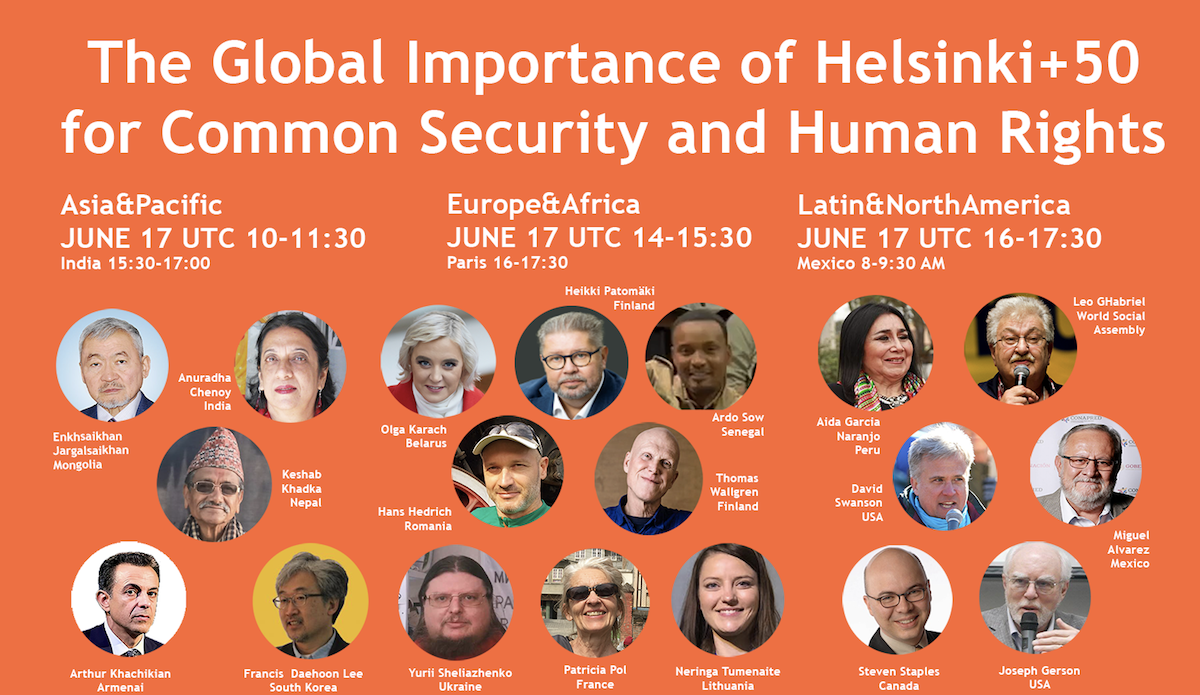
Three webinars – one for Asia & Pacific, a second for Europe & Africa, and a third for South & North America – took place on June 17. The idea was to underline the continuing importance of the “spirit of Helsinki” in spite of all the ongoing wars and rearmaments. The goal of the webinars, to reach out to all main popular movements and a broad range of regions world-wide as well as qualified expertise in the field was reached, writes Tord Björk, Coordinator of Nordic Peace Alliance Helsinki+50 working group, in the following report.
The online process of The Helsinki+50 People’s Initiative got off to a good start on June 17. 70 people (in addition to the 7 interpreters) participated in at least one of the three webinars. There was one webinar for Helsinki+50 -related questions in Asia & the Pacific, one for Europe and Africa, and one for the Americas). The first and last ended in time, the middle lasted an extra 15 minutes. Speakers from 18 countries participated.. All 6 speakers in the first , and all 12 in the second session contributed as planned. In the last session one speaker was ill and another had problems to attend due to travelling. The gender balance between the speakers was good in the Euope&Africa session , but less good in the first and and last where male speakers dominated. The geographic balance was quite good except for Africa, which had only few speakers and participants.
The goal to reach out to all main popular movements and a broad range of regions world-wide as well as qualified expertise in the field was reached.
Via Campesina was present from Nepal and West Africa. Trade unions from Italy by CGIL Friends of the Earth from Finland and one of the moderators. The migrants initiative was represented by a speaker from Middle America. Attac from France, Human rights movements from Belarus, anti racist movement from Lithuania were among the speakers. Different strands in the peace movement: Inrernational Peace Bureau (IPB) from Mongolia, India, and Canada, World Beyond War (WBW) from Romania and the US, Womens’ International League for Peace (WILPF) from Germany, Global Women Against Nato (GWUAN) from Hungary, The Ukrainian consciousness objector’s movement , the neutrality movement from Austria and the World Social Forum (WSF) from Senegal.
Expertise from Finland, Mongolia, South Korea, India, Armenia, Lithuania, Austria, and Mexico as well as other places and contributed knowledge and analyses to the general Helsinki+50 public debate.
The first webinar (Asia & Pacific) showed the usefulness to look at the Helsinki conference 1975 and its outcome from an outside perspective. At the time of the Helsinki Accords 1975 Europe was almost admired for being on a rather stable path to detente, trust building efforts, and arms control agreements as well as defense of human rights. Today this has shifted as the West is seen as abolishing diplomacy and all what the Helsinki spirit stands for. More and more the West is seen as hypocritical and using double standards.
The Europe&Africa session became dynamic with many voices, 5 of the speakers coming from Central and Eastern Europe making up almost half of the speakers from Europe which is quite uncommon and much wanted. It was refreshing to hear a speech in French by Patricia Pol from Attac France. An analysis of the colonial attitudes hidden in official Helsinki+50 and European including Eastern European historical narratives were scrutinized by Neringa Tumenaite from Lithuania. Olga. Karach from Belarus, who is the chief of “Our House”, now working from Vilnius, warned that the autocratic methods of the Belarusian goverment are spreading to the Western world. She called for avoiding double standards when addressing human rights. Heikki Patomäki made the most in debt analysis of the Helsinki Final act from 1975 and commented there by also on the draft Helsinki+50 People’s Declaration. Patomäki pointed at the contradiction between individual and communitarian rights in both documents and said that the contradiction is not solved the way it was written then or now in the draft People’s declaration. However, applying John Stuart Mill’s so called Harm Principle — that the actions of individuals should be limited only to prevent harm to others — might be a way out of this dilemma, he said.
The South and North America session addressed immediate peace concerns in the US and Canada framed by the news that all bank accounts of WBW and the whole of David Swanson family have been closed. The acute migrant crisis when the US has closed its borders as well as the need for conflict resolution was also discussed. The need to find practical solutions for people affected by conflicts both on Middle America and Ukraine was discussed with participants in the webinar. Leo Gabriel from the World Assembly of Struggles and Resistances of the WSF (WASR) summarized the situation as now civil society has to trust each other and cannot trust governments anymore.
WASR with the help of Rosy Zuñiga provided interpreters on volunteer basis. Lack of clear instructions in time from the organizers contributed to some confusing resulting in that the Europe&Africa session was recorded only in Portuguese. The other sessions are recorded in English and the last also in Spanish.
The short time frame made it necessary to send many requests resulting in what can be seen as too many speakers from Europe. To get a broad range of speakers was prioritized before getting many in the audience the highest attendance was from Sweden followed by Finland followed by Austria and then only one or two from other nations.
A step was made to make the Helsinki principles and their current usefulness known hopefully in a broad range of movements while contributing to a qualified discussion of their relevance today and Helsinki+50 Prople’s Declaration. Next step is continue this discussion until July 7, finalizing it and get signatures and organize activities in Helsinki July 30 to August 2.
Tord Björk
 helsinkiplus50.org
Leave a comment